
Programming
- Programming is used generally to build applications & Scripting to automate the workflow
- Applications:
- Command line applications
- Desktop Applications
- Mobile Applications
- Web applications
- Technologies used to Develop
- Command Line Application:
- java, C, C++, Python, C#, node js …
- bash or powershell
- Desktop Applications:
- C#, node js, python…
- Mobile Applications:
- Kotlin
- Swift
- react native (java script frameworks)
- Web Applications:
- java, Python, C#, node js …
- angular, react, vue
- HTML, CSS, Javascript
- Command Line Application:
- How does program run ?
- Operating systems create process
- Application will be single process or multiple processes
- Each process has a unique id (PID) and it gets cpu and memory
- memory stores the necessary data for application
- cpu is executing the instructions
- Options:
- Compiler: Programs are converted into instructions which OS understands
- Interpretor: Programs are translate while execution.
- Hybrid
How to write programs ?
- Approach: Find out more in classroom recording
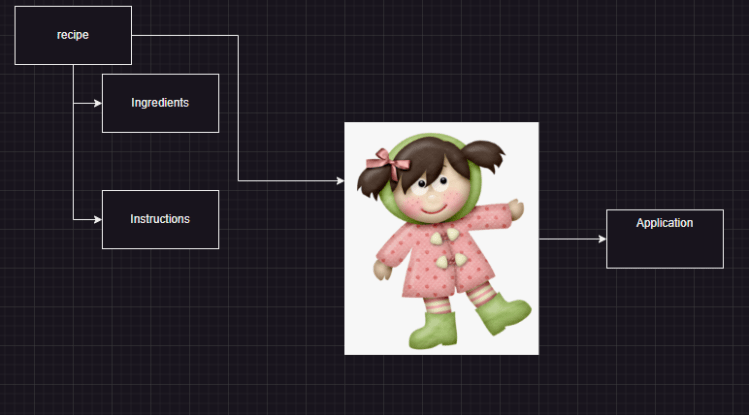
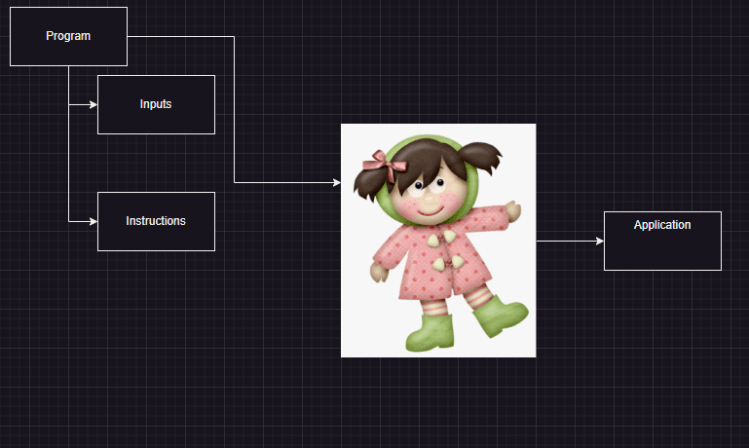
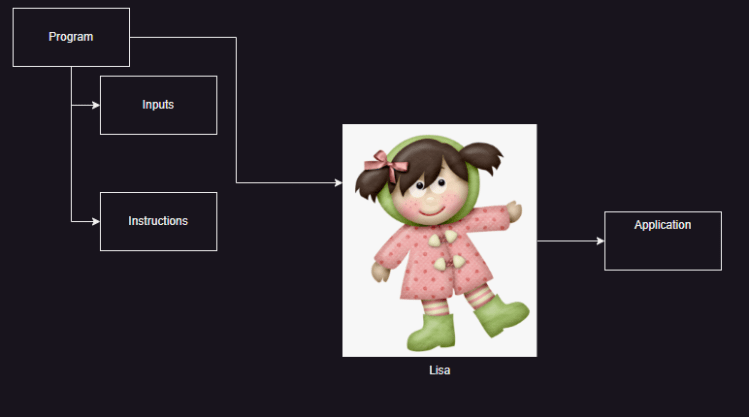
Problem 1:
- Lisa knows how to add numbers
- instruction format
add 3 & 5
- Make her multiply 5 * 5
- Solution: Represent the problem
- add 5 + 5 + 5 + 5 + 5
Probem 2:
- Lisa knows how to
- multiplication
- division
- remainder
- addition
- Example: Sum the number plate
- 432 => 4 + 3 + 2 => 9
- 164 => 1 + 6 + 4 => 11 => 1 + 1 => 2
- Problem: my number number is 414
- 414 % 10 => 4
- 414 /10 => 41
- 41 % 10 => 1
- 41 /10 = 4
- 4 % 10 = 4
Understanding memory allocations
- Allocating memory requires specifying size and generally we get a memory address
- Programming languages use data types where we indirectly specify sizes
- to access memory locations we take help of references (Variables or constants)
int i = 10;
string name = "hello" ;
- We have needs for memory sizes
- fixed size: these are referred as mutable types
- variable size: new memory has to be allocated for every change.
- Programming Languages: Support two types
- Automatic memory cleaning (Garbage collection)
- Manual memory cleaning
- Static Typed Languages and Dynamically Typed Languages
- In Static typed languages (C, C++, Java, C#) we need to specify type for every memory allocation and in dynamically typed languages (python, javascript, bash) type is decided based on value passed to it


