Custom Resource Definitions (CRD) & Operators
CRDs extend the k8s api by allowing users to define new resource types.
CRDs define the schema for custom resources
CRDs expose API Endpoints
CRD’s are yaml specs
Operators use those resources to automate lifecycl management of applications & infra
Operatars implement the logic for thos custom resources actively monitoring the state and taking actions to reconcile. Operators use a control loop
Operators can be developed in python or Go
Refer Here for docs of CRDs with controllers Refer Here for operatorsA Sample CRD YAML
apiVersion: apiextensions.k8s.io/v1
kind: CustomResourceDefinition
metadata:
  name: sampledb.qt.example.com
spec:
  group: qt.example.com
  versions:
    - name: v1
      served: true
      storage: true
      schema:
        openAPIV3Schema:
          type: object
          properties:
            spec:
              type: object
              properties:
                dbType:
                  type: string
                replicas:
                  type: integer
                storageSize:
                  type: string
  scoped: Namespaced
  names:
    plural: sampledbs
    singular: sampledb
    kind: SampleDB
    shortNames:
      - sdb
The custom Resource spec will be as shown below
apiVersion: sampledb.qt.example.com/v1
kind: SampleDB
metadata:
  name: my-sampledb
spec:
  dbType: postgres
  replicas: 1
  storageSize: "1Gi"
Now we need to build th operator/controller using k8s operator sdk Refer Here and kopf a framework in python
Popular operators
Operator Name
Purpose / Functionality
Prometheus Operator Automates deploying and managing Prometheus, Alertmanager, ServiceMonitors, etc. (Medium , CNCF )
Strimzi (Kafka Operator) Manages Kafka clusters, topics, users, MirrorMaker, etc. (Medium , adaltas.com )
Elastic Cloud on Kubernetes (ECK) Automates Elasticsearch, Kibana, APM deployments. (CNCF , @knowledgehut )
PostgreSQL Operator Manages PostgreSQL clusters with backups, scaling, failover. (Medium )
MySQL Operator Automates MySQL deployment, backups, replication. (Medium )
Vault Operator Manages HashiCorp Vault for secrets, rotation, policies. (Medium )
Cert-manager Operator Automates TLS certificate issuance and renewal. (CNCF )
Crossplane Manages cloud resources (e.g., AWS, GCP) via Kubernetes CRDs. (CNCF )
Kong Gateway Operator Deploys and configures Kong API gateway via Kubernetes. (Wikipedia )
TiDB Operator Deploys and manages TiDB (MySQL-compatible HTAP database) in Kubernetes. (Wikipedia )
Prep for Service Mesh
Create an AKS Cluster and deploy AKS Store Apply
NS=shop
kubectl create namespace $NS
kubectl apply -f https://raw.githubusercontent.com/Azure-Samples/aks-store-demo/refs/heads/main/aks-store-all-in-one.yaml -n $NS
Architecture of this application
Service Mesh
A service mesh is an infra layer that manages how microservice communicate with each other, Instead of puhsing networking and observability logic into application code it delegates these responsibiliteis to meesh of sidecar proxies (envoy proxy ) that run alongside servers
Main features of Service mesh
Traffic Management:
Load Balancing, request routing, retries, timeouts
Service Discovery
Security:
mTLS
Automcatic Certificate & key management
Access Policies
Observability:
Policy & Governance
Resilience
Circuit breaking
Fault Injection
Popular Service Meshes
Istio
Traffic management:
Advanced routing
HTTP headers
weights
regex
Canary
A/B
mirroring
Security:
mTLS
integrates with enterprise identity products
fine-grained RBAC
Observability:
Native INtegration with Prometheus and grafan, jaeger, Kaili
Rich telemetry
Extensibility
Linker d:
Traffic Management
retries, timeouts
less advanced routing than istion
security:
Observability:
Golden metrics (latency, traffic, error,saturation)
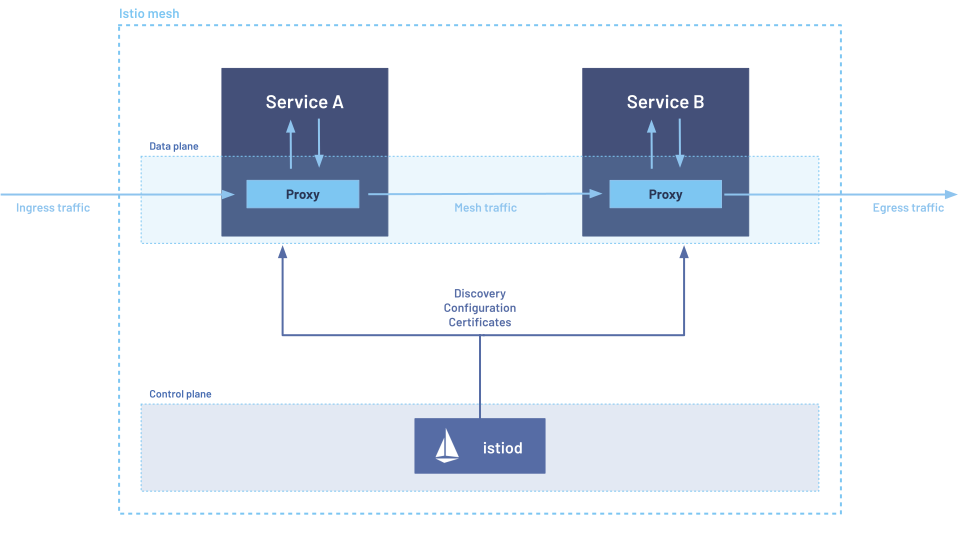
Istio Architecture
Installation
az aks mesh enable --resource-group $MY_RESOURCE_GROUP_NAME --name $MY_AKS_CLUSTER_NAME
kubectl label ns shop istio.io/rev=asm-1-25 --overwrite

# restart workloads to get envoy sidecars
kubectl -n shop rollout restart deployment
apiVersion: security.istio.io/v1beta1
kind: PeerAuthentication
metadata:
  name: default
  namespace: shop # Apply to the 'default' namespace
spec:
  mtls:
    mode: STRICT
Put north-south traffic (external-to-internal) through ingress gateway
lets patch svc store-front to use clusterIp
kubectl -n shop patch svc store-front -p '{"spec": { "type": "ClusterIP" }}'
apiVersion: networking.istio.io/v1
kind: Gateway
metadata:
  name: shop-gateway
  namespace: shop
spec:
  selector:
    istio: aks-istio-ingressgateway
  servers:
  - port:
      number: 80
      name: http
      protocol: HTTP
    hosts:
    - *
---
apiVersion: networking.istio.io/v1
kind: VirtualService
metadata:
  name: store-front
  namespace: shop
spec:
  hosts:
  - *
  http:
  - route:
    - destination:
        host: store-front.shop.svc.cluster.local
        port:
          number: 80
apiVersion: networking.istio.io/v1beta1
kind: VirtualService
metadata:
  name: my-service
spec:
  hosts:
  - my-service
  http:
  - route:
    - destination:
        host: my-service
        subset: v1
      weight: 90
    - destination:
        host: my-service
        subset: v2
      weight: 10
---
apiVersion: networking.istio.io/v1beta1
kind: DestinationRule
metadata:
  name: my-service
spec:
  host: my-service
  subsets:
  - name: v1
    labels:
      version: v1
  - name: v2
    labels:
      version: v2
apiVersion: networking.istio.io/v1alpha3
kind: VirtualService
metadata:
  name: my-service
spec:
  hosts:
  - my-service
  http:
  - route:
    - destination:
        host: my-service
        subset: v1
    retries:
      attempts: 3
      perTryTimeout: 2s
      retryOn: 5xx,connect-failure